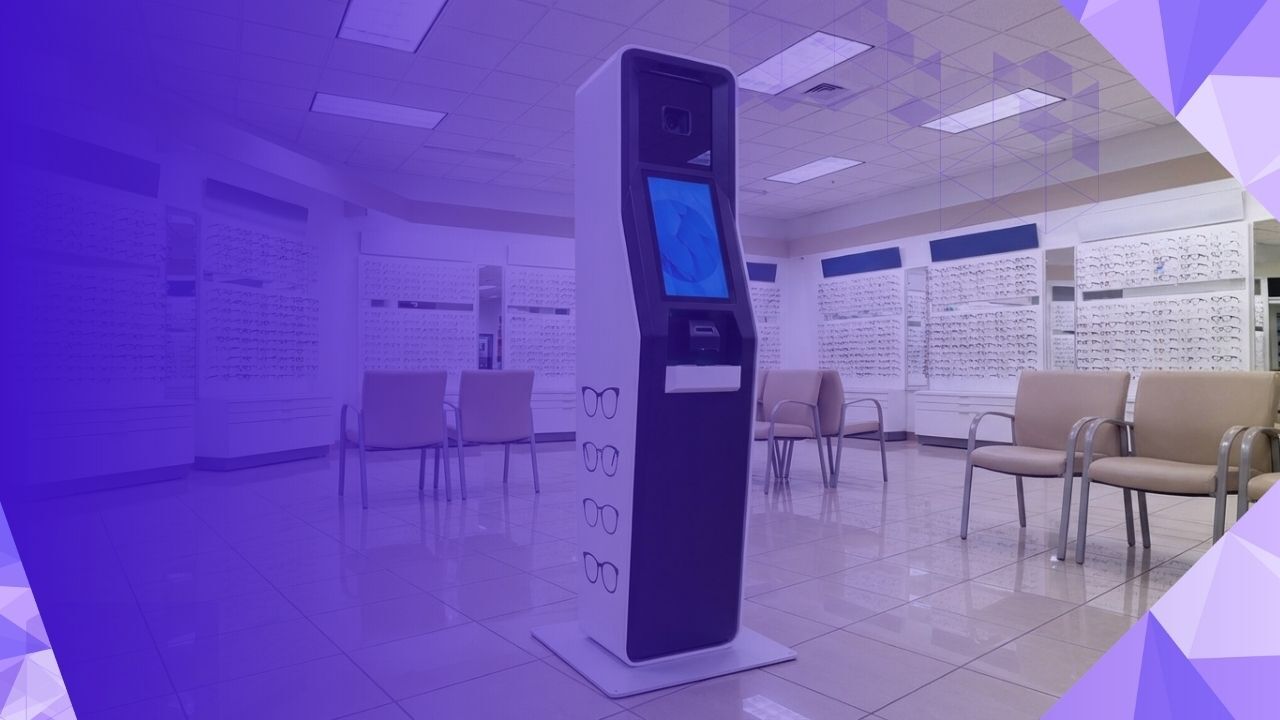
At CES 2026 in January, a company called Eyebot and The Framery at 1-800 Contacts stood on stage and announced something most optometrists haven't heard about yet. They're building what they call an "end-to-end optical experience." Permanent retail locations are planned for later this year.1
If that phrase doesn't land with any weight, consider what it means in practice. A patient walks into a retail location. An AI-powered kiosk scans their eyes in 90 seconds. A tele-optometrist reviews the results remotely and issues a prescription. The patient picks out frames from 1-800 Contacts' inventory. They walk out with glasses ordered and a digital prescription in hand. No independent OD was involved at any step.
Eyebot Is Small. The Trajectory Isn't.
Eyebot launched its Walmart pilot in December 2025 with 13 Walmart Vision Centers and 4 Sam's Club locations in Pennsylvania.2 That's 18 kiosks. Not exactly a national rollout. But the funding tells a different story. General Catalyst led a $20 million Series A in August 2025, on top of a $6 million seed round the year before.3 Zenni Optical has its own deal with Eyebot, placing kiosks in New England malls where customers can test and buy $49 glasses in a single visit.
The pattern here is familiar. A well-funded startup builds a foothold in one geography, proves the unit economics, then scales. Eyebot can't do contact lens fittings yet. It handles eyeglass prescriptions and can update existing CL prescriptions, but initial fits still require a doctor. That limitation won't last forever.
The AOA Noticed
The American Optometric Association filed alerts with both the FTC and the FDA regarding potential violations of the Eyeglasses Rule.4 The Pennsylvania Optometric Association issued a patient safety alert. More than 1,500 optometry students from 13 schools coordinated formal letters protesting the Walmart deployment.5
Their concerns are specific. Eyebot kiosks can't measure intraocular pressure or screen for glaucoma, cataracts, or systemic conditions that are detected during a comprehensive eye exam. The AOA's position is that "direct-to-patient technology should not be used as a replacement for a comprehensive eye exam."4 Some of the Pennsylvania kiosk locations had an in-person optometrist before Eyebot arrived, which looks less like expanding access and more like replacing it.
The professional backlash is real. But backlash alone doesn't change a business model backed by $26 million in venture capital and a partnership with the largest online contact lens retailer in the country.
The Capture Rate Problem Underneath This
Contact Lens Spectrum's 2025 practitioner survey found that 61% of contact lens patients purchase from their prescribing practice.6 That's up slightly from 59% the year before. But online purchases jumped from 23% to 28% in the same period, a five-percentage-point swing in a single year.6
When you ask ODs to estimate their own capture rate, the typical guess is around 90%.7 The gap between perceived and actual is where the revenue disappears quietly.
The annual supply rate sits at roughly 26%.8 Three out of four patients who do buy from the practice aren't committing to a full year. They're buying a few months at a time, which means they're making a repurchase decision every quarter. Every one of those decision points is a moment where convenience wins.
What the Kiosk Solves (and What It Can't)
Eyebot doesn't exist because someone invented a clever kiosk. It exists because vision care faces friction that independent practices haven't fully solved. A typical in-office contact lens order takes 28 steps and roughly 15 minutes of staff time.9 Across a year, that adds up to more than 325 hours of staff labor spent on ordering alone.9
Kiosks solve the friction problem by eliminating the practice entirely. That's one approach. The other approach is eliminating the friction while keeping the practice at the center of the relationship.
Practices that have invested in digital ordering tools report processing times under a minute per order. Patients can reorder at 11 PM on a Saturday without calling anyone. The prescription, insurance benefits, and rebate information are already loaded. There's no 28-step process, no phone tag, no fax.
That's the difference between competing on convenience and conceding on convenience. If a patient's only two options are "call my doctor's office during business hours" and "tap a button on 1-800 Contacts at 9:30 PM," the outcome is predictable. But if their practice offers the same frictionless experience with the added benefit of a clinical relationship, the math changes.
The Friction Problem Is the Whole Problem
This is the point we keep coming back to. Eyebot didn't get $26 million in funding because kiosks are exciting technology. It got funded because the patient experience at most practices still has too much friction, and investors see that as an opening.
A patient who has to call during business hours to reorder lenses will eventually find an easier option. A patient who waits on hold while staff pull up their file, confirm insurance, check inventory, and process an order across 28 steps is being pushed toward the path of least resistance. And now that path leads to a kiosk in a Walmart and an app from 1-800 Contacts.
Independent practices still have something kiosks don't: a clinical relationship that catches glaucoma a kiosk can't screen for, and fits scleral lenses a machine can't measure. Twenty years of trust with a patient is built in the exam chair, not at a terminal.
But that relationship doesn't protect you if the reordering experience pushes patients away between visits. The practices that hold onto their patients are the ones that made ordering as easy as the competitors did. Prescription, insurance, and rebates are all loaded. Reorder at 11 PM on a Saturday. No phone call, no fax, no 28 steps. The clinical relationship stays at the center because the friction around it is gone.
That's what a contact lens operating system actually looks like. Not a single piece of software. A workflow that runs from the exam chair to the patient's front door, at 2 PM or 2 AM, with no gap where a competitor can step in.
One Thing to Do This Week
Pull your last 90 days of contact lens data. How many prescriptions were written versus how many orders were placed through your practice? If you don't know that number, you're in the same spot as the ODs who guess 90% and find out it's 61%.
That number tells you how big your friction problem is. And right now, companies with $26 million in venture funding are betting they can solve it faster than you will.
If you want to see what it looks like when the friction is gone, see what your patients see. Two minutes. It might change how you think about the last mile of your contact lens workflow.
1 PR Newswire, "Eyebot and The Framery at 1-800 Contacts Debut End-to-End Optical Experience at CES 2026," January 2026.
2 Eyebot, "Walmart and Sam's Club Pilot Fast, Affordable Eyeglass Prescriptions Using Eyebot's Technology," December 2025. eyebot.co
3 TechCrunch, "Eyebot gets $20M Series A to expand eye care access," August 2025.
4 AOA, "AOA Addresses Eyebot Technology," 2026. aoa.org
5 AOA, "Walmart's Vision Kiosks, Lowered Standard Prompt Massive Student Protest," 2026. aoa.org
6 Contact Lens Spectrum, "Contact Lenses 2025," January/February 2026. clspectrum.com
7 Modern Optometry, "Increase Your Contact Lens Capture Rate," March 2022. modernod.com
8 Review of Optometric Business, "The Contact Lens Equation: Two KPIs That Grow Your Practice," December 2025. independentstrong.reviewob.com
9 Modern Optometry, "Increase Your Contact Lens Capture Rate," March 2022. modernod.com